Concrete Sidewalk Installation: Sansom Park Property Owner's Guide
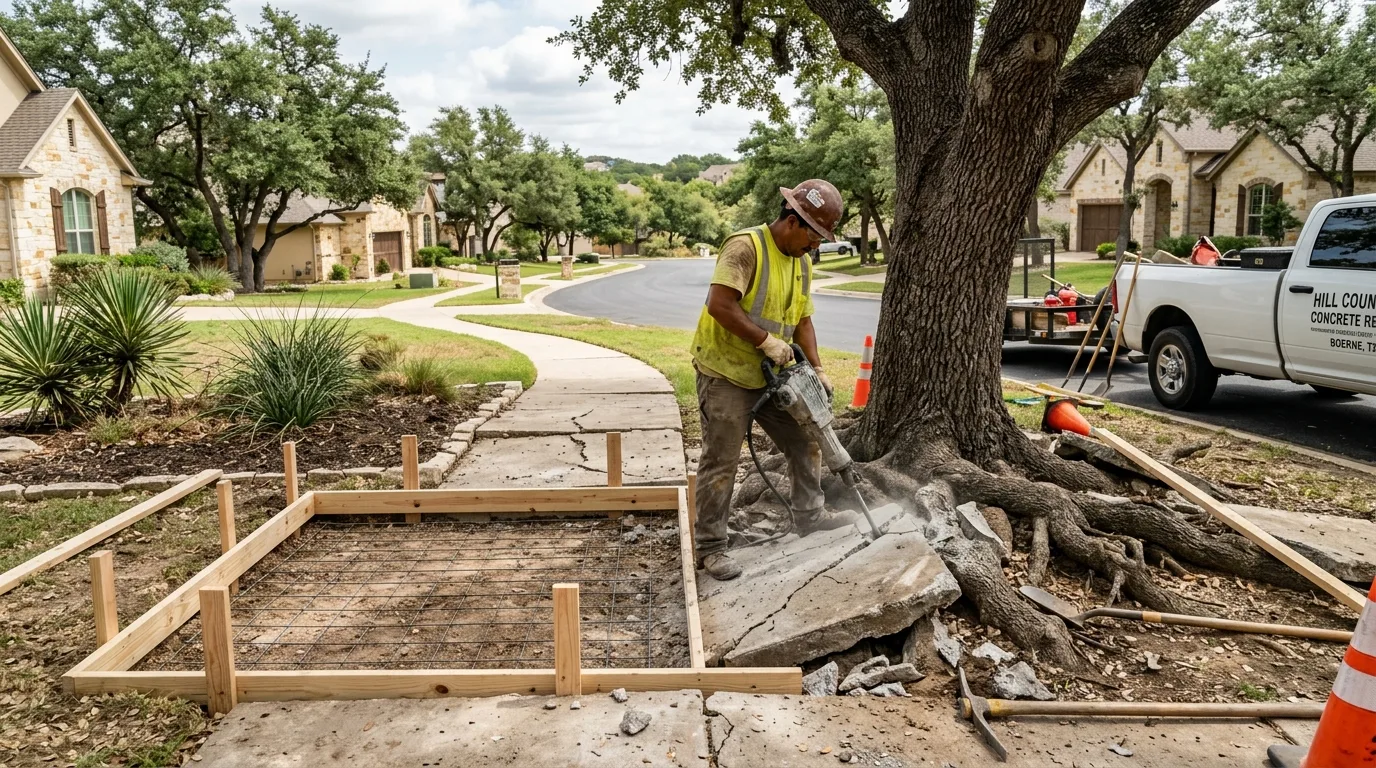
Concrete sidewalks in Sansom Park serve multiple purposes: they provide safe pedestrian access across property with expansive clay soil that turns to mud in rain, they improve curb appeal, and for commercial properties they support ADA compliance requirements. Whether you’re replacing a cracked walkway in a River Oaks neighborhood, adding a path through your backyard, or installing a commercial sidewalk that meets city spec, the requirements and process are similar — but the details matter, especially when Tarrant County’s clay soil is beneath the work.
In this guide, we cover sidewalk installation basics for Sansom Park property owners: when permits are needed, what proper installation looks like, how ADA requirements apply, and what the project will cost.
Concrete Sidewalk Estimate in Sansom Park
Free estimates for residential and commercial walkway installation, replacement, and repair.
Why Concrete Sidewalks in Sansom Park Need Proper Base Prep
The same Houston Black Clay that causes foundation and driveway problems in Tarrant County affects sidewalks. Walkways installed directly over native clay without proper base preparation will heave, crack, and develop trip hazards within a few years. The pattern is familiar: the clay absorbs rainwater, expands, lifts the slab; drought follows, clay contracts, a void forms beneath the slab; the next rain cycle pushes the slab in a slightly different direction; over time, sections shift enough to create dangerous elevation differences.
Proper sidewalk installation on Sansom Park clay requires a 4” compacted gravel base, 4” concrete thickness, wire mesh or rebar reinforcement, and control joints every 4–5 feet. These aren’t optional enhancements — they’re the difference between a walkway that lasts 25 years and one that becomes a liability in 5.
What Concrete Sidewalk Installation Involves
New sidewalk installation follows a predictable sequence. The route is laid out and staked. Existing material (existing concrete, pavers, or native soil) is removed. The subgrade is excavated to the appropriate depth for base material and concrete thickness. Gravel base is spread and compacted. Forms are set along both edges of the walkway, establishing the width (typically 3–4 feet for residential, 5–6 feet for commercial), slope (1–2% cross-slope for drainage, 5% max for accessibility compliance), and elevation. Reinforcement is placed. Concrete is poured and finished.
Finish options for sidewalks: broom finish is standard for most applications (slip-resistant, durable, economical). Exposed aggregate is used where a more decorative appearance is desired. Stamped patterns can be incorporated into walkways that connect to stamped patio areas.
When You Need a Permit for Sidewalk Work in Sansom Park
Sidewalks on private property generally do not require a permit in Sansom Park. The exception is any sidewalk work that extends into the public right-of-way — the strip of land between your property line and the public street. Work in this area requires a permit and must be done by a bonded contractor.
Commercial sidewalks visible from the street may also trigger local development review depending on scope. For most residential projects — replacing a cracked front walk, adding a backyard path, installing a driveway approach walk — permits are not required.
See our full concrete permits guide for Sansom Park for the complete permit breakdown by project type.
ADA Compliance for Commercial Sidewalks
If you own commercial property in Sansom Park — a business, rental property, or multi-family building — the Americans with Disabilities Act (ADA) requires that pedestrian paths be accessible. Key ADA standards for concrete sidewalks:
Width: Minimum 36” clear width (48” preferred for passing room). Wider is required where the path is the only accessible route.
Cross-slope: Maximum 2% (1:50) cross-slope perpendicular to the direction of travel. This is the spec that flat-looking sidewalks most often fail on — a surface that appears level can easily exceed 2% cross-slope.
Running slope: Maximum 5% (1:20) in the direction of travel. Steeper grades require handrails and become ramps with different standards.
Curb ramps: Where the path connects to a parking area, street crossing, or change in level, ADA-compliant curb ramps with truncated dome detectable warning surfaces are required.
Surface: Non-slip, firm, stable. Standard broom-finish concrete meets these requirements when installed correctly.
ADA-Compliant Sidewalk Installation in Sansom Park
We install commercial sidewalks to ADA spec and can assess existing walkways for compliance. Free estimates.
Practical Uses: Common Sidewalk Projects in Sansom Park
- Front entry walks: The path from driveway or street to the front door. Typically 3–4” wide, broom finish, 4” thick.
- Backyard paths: Connecting patio to garage, garden, or outbuilding. Can incorporate stamped or exposed aggregate for visual continuity with adjacent patio.
- Side yard walkways: Utility paths along the side of the house. Functional, typically plain finish.
- Commercial entry walks: Required for ADA compliance on commercial properties. Wider, flatter, and built to tighter spec than residential.
- Driveway-to-door walkways: Short connections between a driveway and entry. Often integrated into driveway projects.
The Process: How We Install Sidewalks in Sansom Park
A new residential walkway project starts with layout: we mark the route with spray paint or stakes to confirm the path, width, and connection points meet your preferences. Existing concrete or material is saw-cut and removed if applicable. Subgrade is excavated 4–6” below the planned top surface. Compacted gravel base is installed at 4” depth. Forms are set and leveled to the correct slope and height. Wire mesh is placed on chairs. Concrete is poured, struck off to the form height, and broom-finished or otherwise finished per scope. Curing compound is applied. Forms are removed after 24–48 hours.
Cost Factors for Sidewalks in Sansom Park
Residential concrete sidewalks in the Fort Worth area run $7–$12/SF installed for standard broom-finish work. A typical 3’ x 20’ front entry walk (60 SF) runs $420–$720. For commercial sidewalks with ADA compliance requirements, plan for $10–$14/SF due to tighter tolerances and potential curb ramp work. Decorative finishes (exposed aggregate, stamped) add $2–$5/SF to the base installation cost.
For a full pricing breakdown by project type, see our concrete cost guide for Sansom Park.
Frequently Asked Questions
How wide should a concrete sidewalk be in Sansom Park?
For residential front entry walks, 3–4 feet is standard. For backyard utility paths, 3 feet is functional. For commercial applications or any path that must meet ADA standards, minimum 36” clear width with 48” preferred. For paths expected to accommodate two people side-by-side, 5–6 feet is appropriate.
Do I need a permit to replace a cracked sidewalk on my property?
Replacing a sidewalk on private property in Sansom Park generally does not require a permit. If the replacement extends into the public right-of-way (the parkway between your property line and the street), a right-of-way permit and bonded contractor are required. Contact Sansom Park City Hall at 817-626-3791 ext. 114 with questions about specific projects.
How long does a concrete sidewalk last in Sansom Park?
With proper base preparation and reinforcement, a concrete sidewalk on Sansom Park clay should last 20–30 years. Without adequate base prep, expect significant cracking within 5–10 years as clay movement cycles through wet and dry seasons.
Related reading: concrete permits in Sansom Park | concrete cost guide | concrete sidewalks service page
Concrete Sidewalks in Sansom Park — Free Estimates
Residential and commercial walkway installation, ADA ramps, and repairs. Serving Sansom Park and Tarrant County.